Africa on Film: Out of Africa
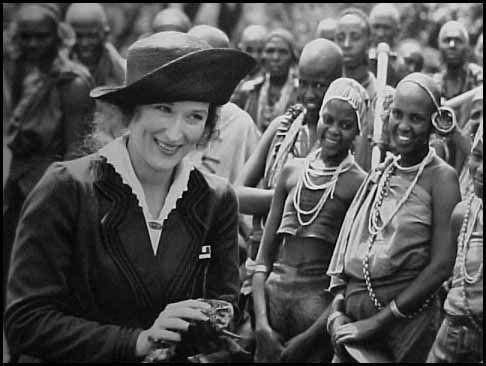
While reviewing this week’s film, Out of Africa (1985), for our series Africa on Film, I wondered what I would write about. Many people have bones to pick with this film but I was unable to distinguish what they were. The grandiose sets of colonial Kenya in the early part of the 20th century are pleasing to the eye, and Meryl Streep’s performance as Dutch Baroness, Karen Blixen, is on point. Having reached the end of the film the second time, I realized that it is precisely the film’s elegant costumes, elaborate sets, and sweeping landscape shots that are problematic.
If you haven’t seen Out of Africa, get a sense of it from the trailer below:
http://www.youtube.com/watch?v=1a8Y0IbK42k
This film’s artful take on the colonial past masks the ugly realities of colonialism. Out of Africa claims some sort of progressive politics on racial and cultural domination by way of its leading white couple, Robert Redford and Streep, but the colonial framework is still very much present.
Redford plays Denys Finch Hatton, a nature-loving, big game hunter who has a sensitive way of understanding the natives and the land (the ideologies that this wanderlust character represents could be written about for pages). With his Masai companion, Hatton leads the audience through Africa’s beautiful untouched bush.
As our guide, Hatton acts as the lens through which Western audiences view colonial Kenya. As long as he is friendly with the natives and respects the land, we don’t have to acknowledge what colonialism really was. The sweeping African landscape seen from the point-of-view of Hatton’s airplane in particular provides a buffer between audiences and colonial realities.
Streep’s character celebrates early feminism. She is proud and knows how to take care of herself alone on her farm (the portrayal of her independence contradicts with the natives she has helping her). Blixen is beautiful, dresses well, and still knows how to shoot a lion.
This woman is a spectacle of all the unrealized dreams of the American woman.
This representation of womanhood is the central reason that I could not see what was wrong with this film. The nostalgia her character creates for a time when an elegant, strong white woman could run a farm in Africa covers up the ugliness of that idea. It undermines key colonial truths, like the fact that her “strength,” or privilege, relies on the colonial order.
Hatton’s sensitivity and Blixen’s feminism, combined with gorgeous cinematography and beautiful sets, creates an “emotional and logical blockage” (to quote a friend of mine) between audiences and colonialism. Glossed, blocked, masked, or covered up, Out of Africa is a nostalgia piece for a time when whites ruled in Africa.
– Allison Swank


